

Payday Super is now part of the normal payroll cycle, but the change may be more significant for a business’s cash flow than it first appears. For directors managing wages, supplier payments, tax obligations and customer receipts, the question is whether the business has adjusted its cash planning to match the new payment requirements.
A business may have been meeting its superannuation obligations under the previous quarterly system without setting aside cash for contributions every payday. That approach needs reviewing. The obligation has changed, and directors need a clear picture of how it affects the money available between pay cycles.
What Has Changed Under Payday Super?
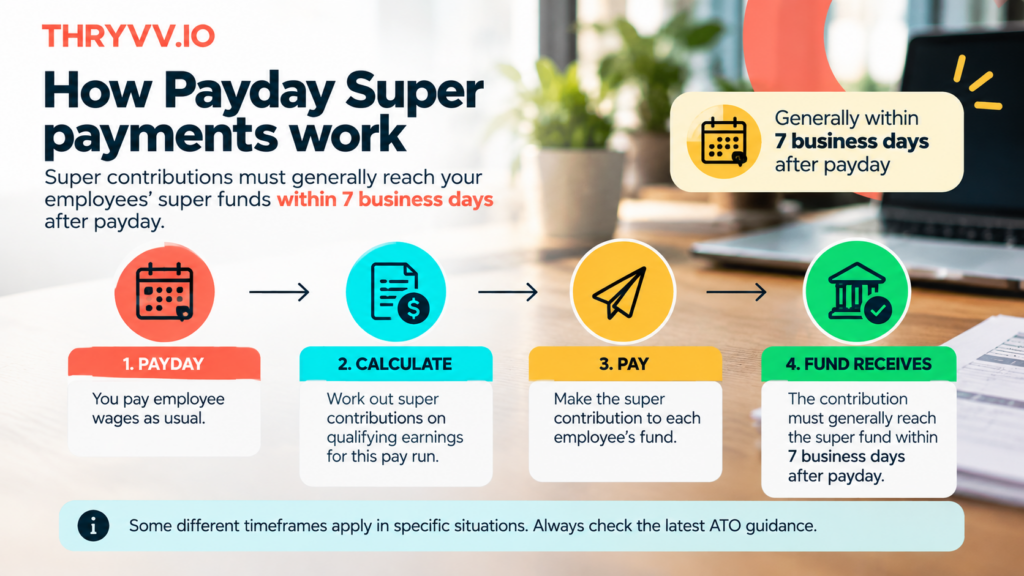
Since 1 July 2026, employers have generally been required to pay superannuation guarantee contributions each payday rather than quarterly. Contributions must ordinarily reach the employee’s super fund within seven business days after payday, although extended timeframes apply in certain circumstances.
The superannuation guarantee rate remains 12%, but contributions are now calculated using qualifying earnings, which can include payments beyond ordinary time earnings. The Australian Taxation Office’s Payday Super guidance explains the new payment, reporting and processing requirements.
For directors, the important distinction is that superannuation is no longer a separate quarterly cash commitment. It needs to be incorporated into the regular payroll process, with enough time allowed for contributions to reach the correct fund.
Why the Timing Matters for Business Cash Flow
Payday Super does not simply change an administrative deadline. It changes when cash needs to leave the business.
Under the previous arrangement, businesses could manage super contributions around quarterly due dates. The new system requires more frequent payments, bringing superannuation into the same planning period as wages and other operating commitments.
This can be particularly relevant where customer receipts are irregular, trading margins are narrow or several obligations fall due together. A business might have sufficient revenue over a month but still experience pressure during an individual pay cycle.
The practical question is whether expected receipts will be available when payroll and super contributions need to be funded. That requires reviewing actual cash availability, not relying solely on the profit and loss statement or the value of outstanding invoices.
What Directors Should Review in Their Payroll Process
The starting point is understanding how super contributions are calculated, processed and confirmed as received.
Directors should establish whether their payroll software supports Payday Super requirements, whether employee fund details are current and whether the payment method allows enough processing time. Rejected contributions or incorrect employee information can create delays that need to be identified and corrected.
It is also worth reviewing who is responsible for checking the payment status. Processing payroll does not necessarily mean every related super contribution has reached the intended fund.
These operational checks should sit alongside a broader review of business management, cash flow and risk controls. Payroll compliance and commercial cash planning need to work together rather than being treated as separate responsibilities.
How Does Payday Super Affect Other Financial Commitments?
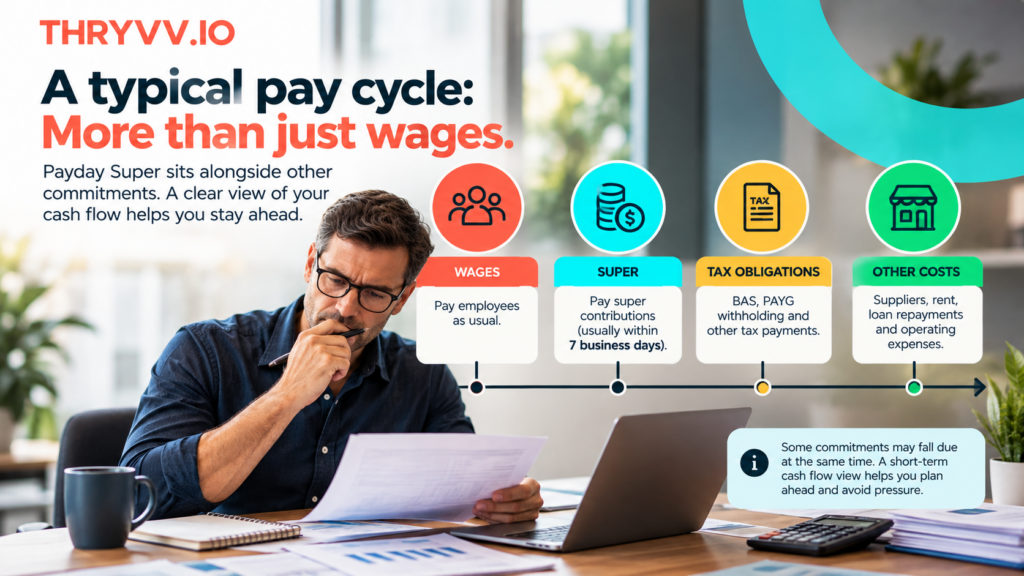
Payroll is only one part of a business’s cash requirements. Directors also need to consider rent, suppliers, tax obligations, loan repayments and the operating costs required to keep trading.
A useful approach is to prepare a short-term cash forecast that identifies each payday, the associated super payment, other committed expenditure and the expected timing of customer receipts. Where there is uncertainty about an incoming payment, that uncertainty should be visible rather than treated as available cash.
This connects with the wider issue explored in our article on working capital pressure and business recovery: a business can continue generating revenue while facing difficult decisions about the timing of its payments.
The purpose of the forecast is not to produce a perfect prediction. It is to identify potential gaps early enough for directors to examine their options and obtain appropriate advice.
What If the Business Is Already Under Cash Pressure?
If the business is struggling to meet payroll-related obligations, the position deserves attention beyond a routine software or bookkeeping adjustment.
Directors need to understand which amounts are due, whether contributions have reached the correct funds, what cash is available and which other commitments may affect the business’s ability to meet its obligations. Late or insufficient super payments can have consequences under the superannuation guarantee charge rules.
The ATO has outlined a first-year compliance approach recognising genuine efforts to meet the new requirements, but that should not be treated as permission to delay payment. Errors and outstanding contributions should be addressed promptly, with suitable professional guidance where necessary.
Where the cash position is uncertain, the sensible next step depends on the facts of the business rather than a standard response.
A More Reliable View of the Next Pay Cycle
Payday Super is now an ongoing part of managing a business. The opportunity for directors is to make payroll timing, contribution status and short-term cash requirements more visible, so decisions are based on a realistic financial position.
If you are unsure how the new requirements fit alongside your existing commitments, start a confidential conversation with Thryvv. We can help you examine the commercial position and identify what needs attention next.
Need a clear next step?
If this sounds close to what is happening in your business, start with a confidential conversation. We’ll help you work out what matters first.
or call 07 2143 6020
Free. Confidential. No obligation.
Related support: Manage · What we do