
The accountant has been asked for the numbers. The reports are not ready, there are still transactions to reconcile, and someone is waiting for information before the financial position can be properly assessed.
Meanwhile, the business continues operating.
There may be commitments approaching, a decision about funding, or a question about whether the business can afford its next move. The director needs reliable information, but the person preparing it has not yet finished the work.
Waiting may be necessary for some decisions, but it does not remove the responsibility to understand what is happening in the business.
The starting point is to establish which business financial records are available, what remains outstanding and which information could affect the decision.
When the Numbers Are Delayed, the Business Still Needs Direction
There are legitimate reasons why financial reports take time to prepare. Transactions may require reconciliation, supporting documents may be missing, or adjustments may be needed before the accounts accurately reflect the company’s position.
The problem is not necessarily that the accountant is taking too long. It is that the director may be making decisions without understanding which figures can be relied upon.
A director considering additional borrowing, a significant purchase or a change in operating arrangements needs to understand the financial implications. If the information is incomplete, the uncertainty should be identified rather than filled with assumptions.
The objective is not simply to obtain another report. It is to understand what the report needs to establish and why that information matters.
What Financial Information Is Already Available?
When reports are outstanding, it is useful to separate information that can be accessed from information requiring professional verification.
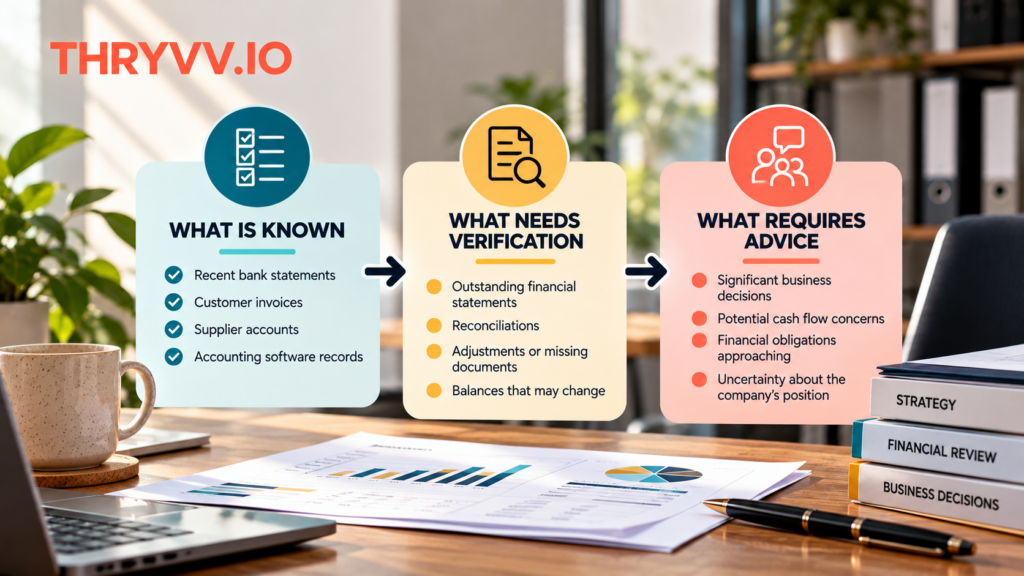
A business may have bank statements, customer invoices, supplier accounts and accounting software records. These provide useful context, but their reliability depends on whether transactions are complete, correctly recorded and reconciled.
The review should distinguish between:
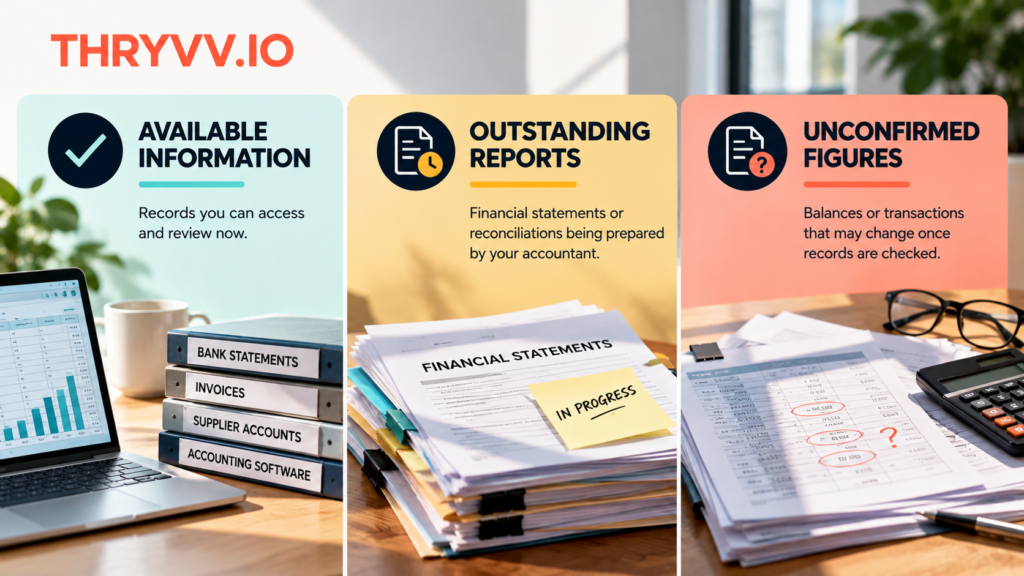
- Available information: Records the director can access and whose status is understood.
- Outstanding reports: Financial statements or reconciliations being prepared.
- Unconfirmed figures: Balances or transactions that may change once checked.
- Decision-critical information: Missing details that could affect the proposed action.
This gives the director a starting point for discussion without treating preliminary information as a complete financial assessment.
The Australian Securities and Investments Commission (ASIC) explains that company officeholders remain responsible for ensuring appropriate financial records are maintained, even when accounting work is handled by others.
Ask for the Information That Matters to the Decision
A general request for updated accounts may not explain what the director needs.
If a decision is approaching, the accountant should understand what is being considered, which reporting period is relevant and what information is needed to assess the implications.
What Should the Director Clarify With the Accountant?
The conversation may need to establish which reports are complete, what is preventing the remaining work from being finalised, whether additional documents are required and when reliable information is likely to become available.
It may also be useful to ask whether particular figures can be verified separately while the broader accounts are being prepared.
This does not mean relying on unfinished reports for decisions they cannot support. It means identifying whether the information gap affects the entire assessment or a specific question that can be addressed sooner.
Not Every Decision Can Wait for Completed Accounts
Some business decisions can be postponed until the financial information is complete. Others involve obligations or commitments requiring earlier attention.
A director may know that payments are approaching or that a proposed commitment needs assessment. What remains uncertain is whether the business has the financial capacity to support it.
As discussed in our article on working capital pressure, the timing of receipts and payments can affect a business even when it continues generating revenue.
If material figures are missing, the director needs to understand what cannot yet be concluded. Incomplete accounts should not become a reason to assume the business is financially sound or that an important commitment is affordable.
Directors Remain Responsible for Understanding the Position
An accountant can prepare reports, reconcile transactions and explain financial information. Those services are important, but they do not transfer the director’s responsibilities to the adviser.
ASIC’s guidance on becoming a company director explains that directors are expected to remain informed about company finances and financial obligations.
Where records are incomplete, the director should understand the gaps and seek assistance to resolve them. If the business may be unable to meet debts as they fall due, timely professional advice becomes particularly important.
Directors do not need to become accountants. They do need to ensure important decisions are supported by information that has been properly examined.
The Next Conversation Should Start With the Decision
When financial information is delayed, I would start by identifying the decision that needs to be made and the figures that could change it.
That may involve working with the accountant to establish what is available, identifying outstanding records or seeking specialist advice where more serious concerns arise.
At Thryvv.io, a Director’s Advocate can help bring those questions into a clearer discussion and identify where additional professional input may be required.
The accountant’s numbers remain important. So does understanding what the director needs those numbers to answer.
If you are waiting for financial information and have a business decision approaching, contact Thryvv.io to arrange a confidential conversation with a Director’s Advocate about your position.
Need a clear next step?
If this sounds close to what is happening in your business, start with a confidential conversation. We’ll help you work out what matters first.
or call 07 2143 6020
Free. Confidential. No obligation.