

There is a point in business pressure where opening another email, finding another document or looking at another number feels like one more problem you don’t have the capacity to deal with.
So things start getting put off.
The accounts aren’t completely up to date. There are figures you don’t have. Someone is waiting for information. You know there are bills coming up, money owed and decisions that need to be made, but getting the whole position organised feels like a job in itself.
The problem is that the business doesn’t stop moving while you get ready to deal with it.
When you’re in that position, I don’t think the first objective should be producing a perfect financial picture.
You need enough reliable information to understand the next decision.
When avoiding the numbers starts costing you decision room
Financial pressure has a way of making everything feel equally important.
A supplier wants payment. Tax obligations may be outstanding. Wages are approaching. Customers owe you money. There might be expected income that hasn’t arrived yet.
Meanwhile, you’re trying to keep the business operating.
Avoiding the numbers doesn’t make those issues disappear. More importantly, it can make it harder to distinguish between the problem making the most noise and the problem that should actually determine what happens next.
This is one of the reasons understanding the stages of financial distress matters. Pressure can develop over time, and what happens next depends on understanding where the business actually stands.
That doesn’t mean you need every answer immediately.
It means you need to start establishing the position.
You don’t need a perfect set of accounts to start the conversation
One misconception I see is that directors think they need to get everything organised before asking for help.
They don’t.
If information is incomplete, that is part of the situation we need to understand.
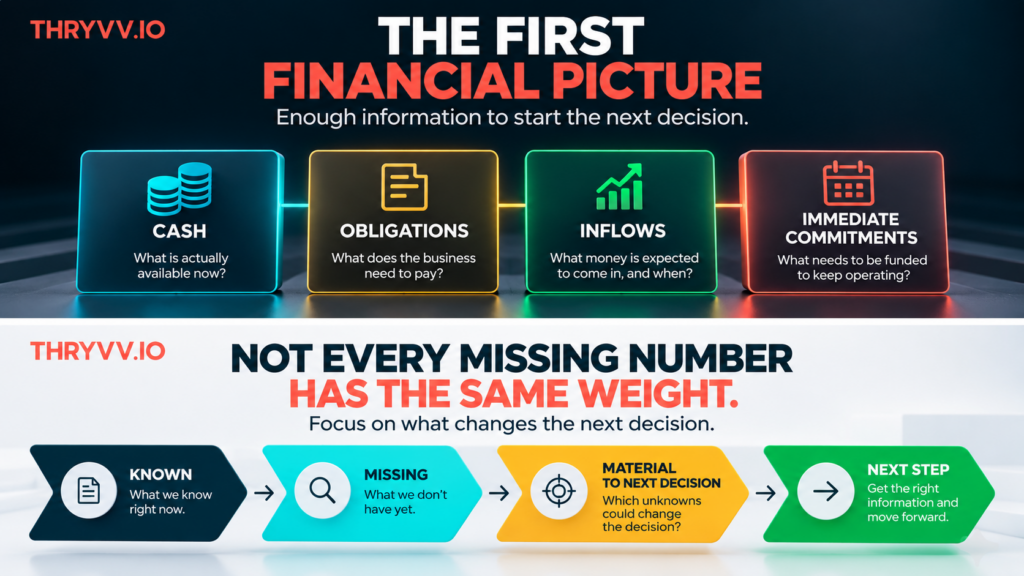
We can start by separating three things:
- what we know;
- what we don’t know; and
- what we need to know before a particular decision can be made.
That distinction matters.
There is a difference between information that would be useful to have and information that could materially change the decision in front of you.
Start with the financial picture that matters now
When a business is under financial pressure, I generally want to understand four things first.
Cash
- What cash is actually available to the business now?
- Not what should be available. Not what might arrive. What is accessible today?
Obligations
- What does the business need to pay?
- That includes understanding the significant obligations already due as well as those approaching.
Inflows
- What money is reasonably expected to come into the business, and when?
- Timing matters. A receivable doesn’t solve today’s cash problem simply because it appears on the books.
Immediate commitments
What does the business need to fund to continue operating in the near term?
Putting these together won’t necessarily give you a complete financial model. But it starts turning a collection of problems into a financial position you can discuss.
This is also where cash-flow recovery and turnaround planning become more useful than simply reacting to whichever problem is making the most noise.

Which missing information could actually change the decision?
Once the first picture is visible, the next question isn’t, “What records are missing?”
It’s, “Which missing information matters to the decision?”
Perhaps the amount or timing of an expected inflow is uncertain. Perhaps an obligation hasn’t been quantified. Perhaps current accounts don’t reflect what has happened recently.
Those gaps don’t all carry the same weight.
The objective is to identify the unknowns that could change the pathway, then work on resolving those first.
When the emotional load is part of the problem
Directors don’t experience financial pressure as a spreadsheet.
There can be frustration, fear, anger, embarrassment and sometimes a strong temptation to simply not look at the problem for another day.
I’ve sat across the table from directors who don’t know where to start.
My view is that you don’t solve that by demanding that they arrive with a perfectly organised file.
You start somewhere manageable.
One number. One obligation. One decision at a time.
What a Director’s Advocate can do when you feel stuck
A Director’s Advocate can help bring the different pieces together and work out what matters first.
That may mean establishing the current financial position, identifying material gaps, coordinating with accountants, lawyers or other advisers, testing available pathways and helping the director understand the consequences of each option.
That’s the approach behind Thryvv.io’s RECOVER support for directors and business owners. The objective isn’t to make every problem disappear at once. It’s to understand the position, preserve the available options and improve the quality of the next decision.
If you’ve reached the point where even looking at the numbers feels difficult, you don’t need to have everything organised before you speak to someone.
Sometimes the first useful step is simply getting the position back on the table.
If this feels familiar, send us a confidential message. We’re here to help you work out what matters first.
Need a clear next step?
If this sounds close to what is happening in your business, start with a confidential conversation. We’ll help you work out what matters first.
or call 07 2143 6020
Free. Confidential. No obligation.