

Financial distress challenges even the strongest businesses, moving them through stages that test stability and decision-making. From early cash flow issues to critical points with creditors, each phase brings unique pressures.
Business financial distress doesn’t usually happen overnight. It develops over time, and the longer the underlying issues remain unresolved, the more difficult the position can become and the fewer options may remain available.
This guide outlines the stages of financial distress, the impact on business owners and managers, and some of the key recovery options available.
Stages of Business Financial Distress
Financial distress doesn’t usually happen overnight; it progresses through identifiable stages, each with its own signs and challenges. Recognising these stages can help business owners understand where they are in the process and what steps they might take to regain control.
Here’s a closer look at each stage and the common issues businesses face along the way.
The Pre-Cursor Stage
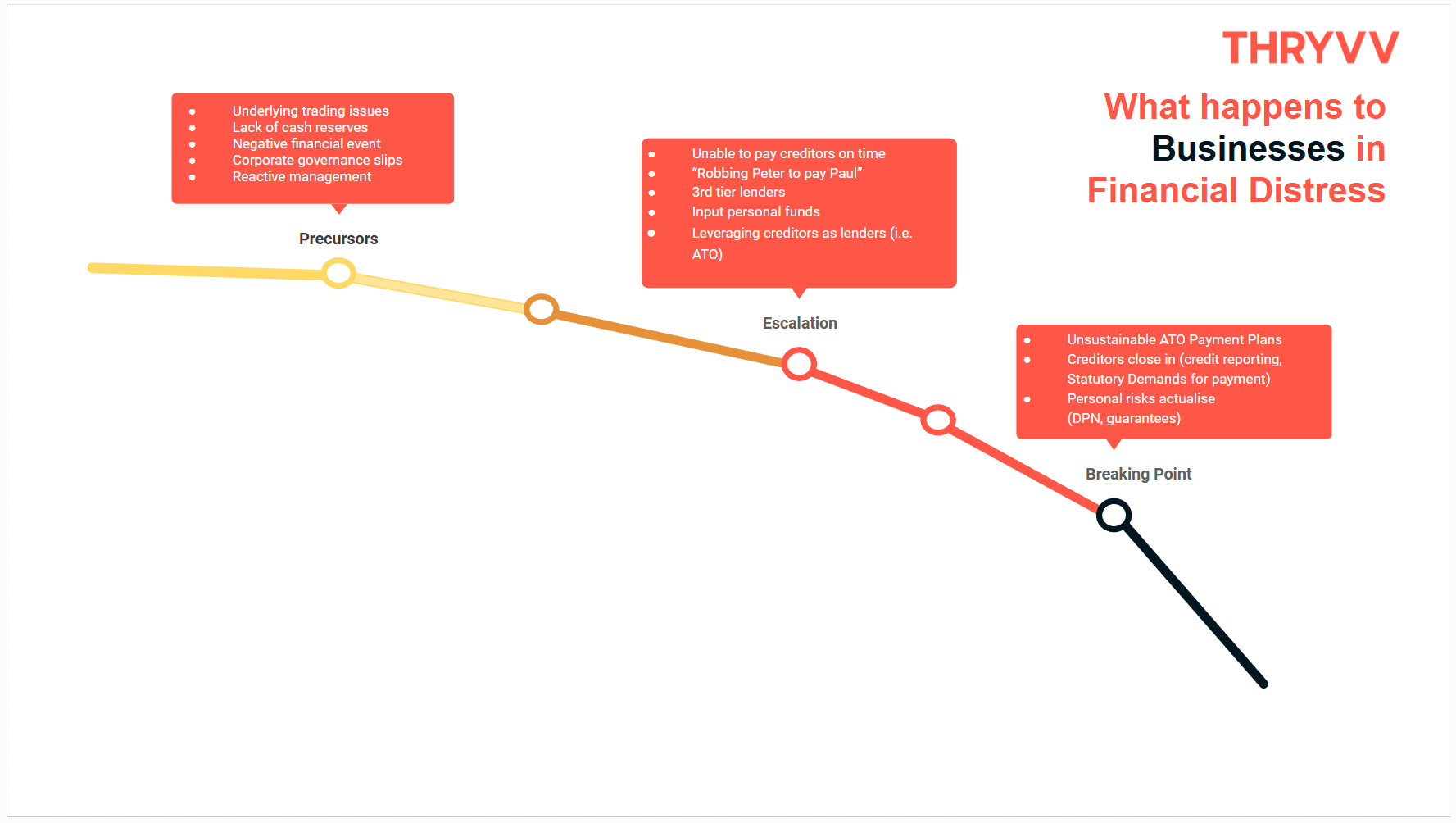
Financial distress can initially be caused by a range of events. For example, underlying trading issues, such as declining sales or increased competition, or a negative financial event, like a significant loss or unexpected expense.
This reduction can have both tangible consequences, like a reduction in cash reserves, and intangible consequences, such as management reactively managing issues rather than proactively doing so.
At this stage, a business may still appear to be operating normally. However, ongoing cash flow problems can be an early indication that there is an underlying problem that needs to be addressed.
The Escalation Stage
During the escalation phase of financial distress, businesses may struggle to pay creditors on time, leading to a cycle of “robbing Peter to pay Paul,” where payments to one creditor are delayed to cover another.
Companies might turn to third-tier lenders for quick cash, often at unfavourable terms, or even inject personal funds to keep operations afloat. Additionally, leveraging creditors as informal lenders, such as the ATO, can provide temporary relief but may further complicate financial relationships and obligations.
These are generally short-term solutions, as the underlying problem isn’t being addressed.
As this continues, the business can move from having a cash flow problem to a much broader financial problem. Creditor pressure increases, management spends more time dealing with immediate issues, and the options available to recover the business can start to narrow.
The Breaking Point
Eventually, the business gets to a breaking point.
When nearing the breaking point, the business may enter unsustainable payment plans with creditors and the ATO, and creditors may start to close in, sending their debts to debt collectors and issuing Creditors’ Statutory Demands.
During this critical time, personal risks also start to materialise, such as the ATO issuing Director Penalty Notices (DPNs) and creditors enforcing personal guarantees, at which stage directors’ assets and reputations may be at significant risk.
The important point is that business financial distress and insolvency are not necessarily the same thing. A business can experience financial distress before reaching the point where insolvency becomes an issue. Understanding the actual financial position of the business is therefore critical before deciding what happens next.
Have you received a Director Penalty Notice from the ATO?
Options When in Financial Distress
When a business is in financial distress, there are a number of options available to address the issues. However, the longer it is left without acting, and the further into distress the business becomes, the options available start to erode.
For example, making staff redundant may not be an option if there is not enough cash available to pay out a redundancy, or a Small Business Restructure may no longer be available if the company is unable to meet the relevant eligibility requirements.
This is why understanding the position early is important. The first question shouldn’t necessarily be, “Which restructuring option should I use?” It should be, “What is actually causing the problem, and what options are still available to us?”
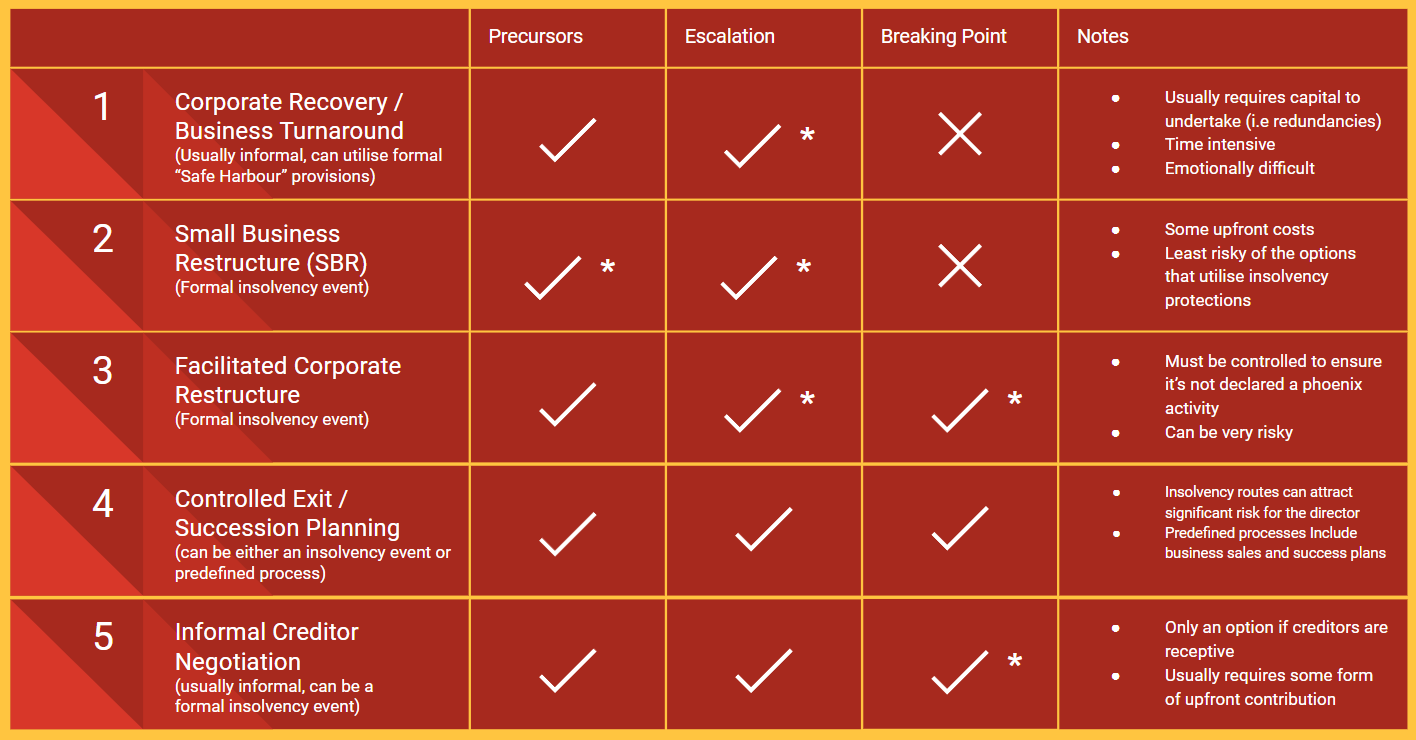
For more information on the options available when in financial distress, see our business recovery options.
The Impact of Financial Distress on Business Owners and Managers
Financial distress doesn’t just affect a company’s finances; it takes a significant toll on those leading the business.
Owners and managers face increasing pressure as they try to steer through difficult times, often at great personal cost. Each stage of distress brings unique challenges, impacting their mental health, decision-making abilities and relationships.
Here’s a look at how financial distress affects business owners and managers at each stage.
The Business Owners and Managers in the Pre-Cursor Stage
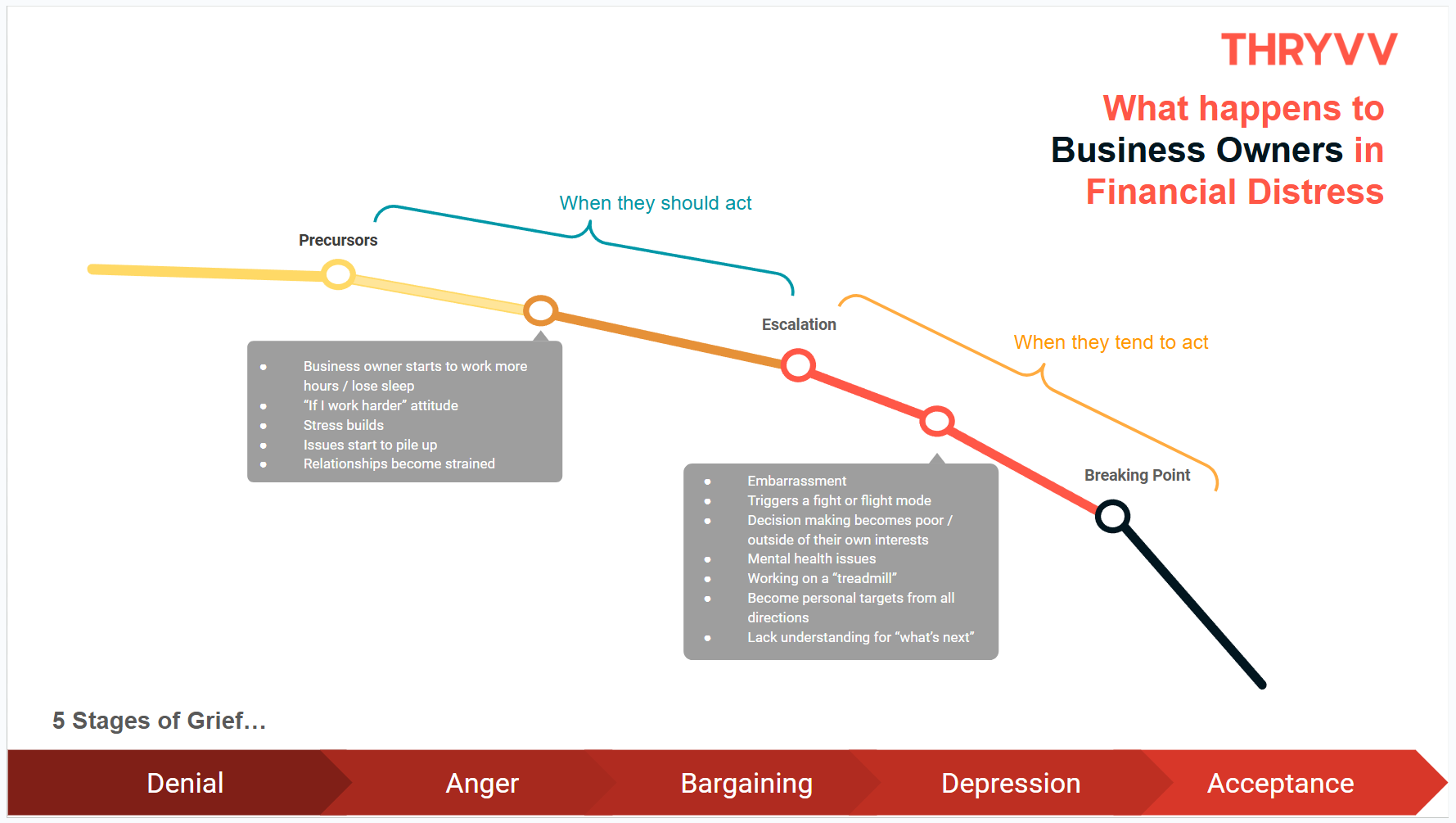
In the precursor stage, business owners often find themselves working longer hours and losing sleep, adopting a mindset of “if I work harder” to overcome challenges.
As stress builds, unresolved issues start to pile up, creating a sense of overwhelm. This pressure can strain relationships with employees, family and friends, as the owner struggles to manage the growing demands on their time and resources.
The mounting stress and urgency for solutions can cloud decision-making, making it difficult to address the core issues effectively.
The Business Owners and Managers in the Escalation Stage
In the escalation stage, business owners often start to experience embarrassment, which can trigger a fight-or-flight response.
Typically, the business owner has now been working long hours for an extended period of time. The psychological and neurological impact of this can significantly hamper effective decision-making, where they start to make poor choices that do not align with their best interests.
Additionally, mental health issues can arise, leading to a sense of working on a “treadmill,” where progress feels elusive.
They may become targets for scrutiny from creditors and others, all while losing the ability to see the path forward and lacking clarity on the next steps to take, exacerbating their stress and uncertainty.
The Stages of Grief
As the issues escalate, the business owner is also going through the stages of grief.
They have poured years of hard work into the business and it is, for lack of any other definition, their child. The business is, in a lot of cases, centrally linked to their identity.
As a result, when in financial distress, the business owner needs to come to terms with the fact that the business is going through issues that it may not be able to recover from. This triggers an emotional grief response that the business owner must work through.
In simple terms, these stages are:

Unfortunately, it takes time to go through this process, and it’s generally only at the acceptance stage where the business owner will open up about the scale of the problem and actively seek help.
Ironically, however, the longer it takes for a business owner to seek help, the fewer options may be available to recover from the distress.
Getting the Right Advice
One of the difficulties with business financial distress is that the problem can change as it progresses.
What starts as a trading or cash flow issue can develop into ATO debt, creditor pressure, personal guarantees, Director Penalty Notices or questions around restructuring and insolvency.
That also means there may be a point where more than one type of advice is required.
Understanding the financial and commercial position of the business is important, but where legal obligations, creditor action or insolvency issues arise, appropriate legal advice may also be required.
The important thing is to understand the problem first and then get the right people around the table to help work through the available options.
The Best Thing to Do – Reach Out for Help
While early intervention is by far the best option available when experiencing business financial distress, we encourage you to talk to a Director’s Advocate, such as Thryvv.io, regardless of what stage of financial distress you are in.
There are a number of great options that could be available to you. For example, your business could be eligible for a Small Business Restructure.
The earlier you understand what is actually happening in the business, the more opportunity you have to assess the options available before circumstances make those decisions for you.
Thryvv.io offers an obligation-free strategy call where we will help you understand your financial position and the options that may be available to you.
Talk to our Director’s Advocate. Schedule a confidential strategy call.
Need a clear next step?
If this sounds close to what is happening in your business, start with a confidential conversation. We’ll help you work out what matters first.
or call 07 2143 6020
Free. Confidential. No obligation.
1 thought on “What Happens to Businesses When In Financial Distress?”