

A business can report a profit and still face difficulty meeting its next payment. For a director reviewing the accounts, that can be confusing. The profit and loss statement suggests the business has earned more than it has spent, yet the bank balance may not be enough to cover the obligations approaching.
The immediate question is often where the profit has gone. Answering it requires looking beyond the profit figure and understanding how money has moved through the business. That distinction matters when a director needs to decide which commitments can be met, what information is missing and whether the cash pressure requires a more detailed review.
Profit Is Not the Same as Cash Available Today
Profit measures financial performance over a reporting period. Cash available today reflects money the business can actually access at a particular point in time. Those figures are connected, but they do not necessarily move together.
For example, a business may record revenue when work has been completed and invoiced, even though the customer has not yet paid. The revenue contributes to the reported result, but the cash is not available to meet an immediate supplier payment. Similarly, certain cash payments may not appear as expenses in the same way or at the same time in the profit and loss statement.
A positive profit figure is useful information about performance. It does not, by itself, establish that the business has sufficient cash to meet every obligation when it falls due.
Where the Profit May Have Gone
Understanding the difference between profit and cash often involves examining movements that are not obvious from the profit and loss statement alone.
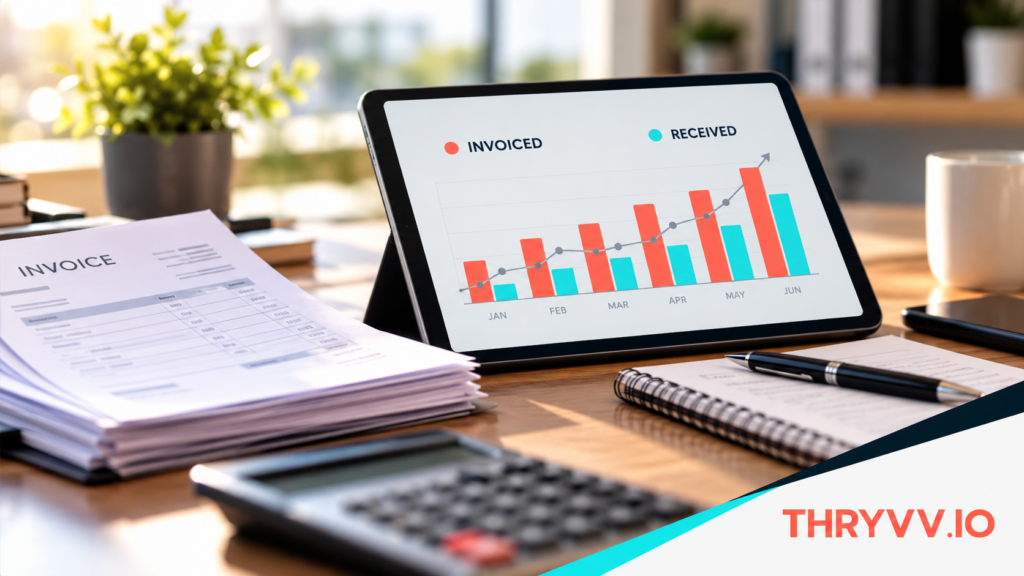
Customer invoices not yet collected
Sales recorded in the accounts may still be sitting in outstanding customer invoices. The business may have completed the work and recognised the revenue, while the money remains unpaid.
The relevant questions are how much is outstanding, when payment is realistically expected and whether the business is relying on receipts that have not been confirmed.
Inventory and other working-capital movements
Cash may also be tied up in stock or other working-capital requirements. A business can use money to purchase materials or maintain inventory before those purchases translate into customer receipts.
Changes in the timing of supplier payments and customer collections can also affect the amount of cash available. Reviewing these movements helps explain why the reported financial result and the bank balance may be telling different stories.
Asset purchases, debt repayments and other cash uses
Money may have been used to purchase equipment, repay loan principal or fund other balance-sheet movements. These transactions can reduce available cash without reducing reported profit by the same amount in that period.
This is why a useful financial review asks two related questions: what did the business earn, and where did the cash go? Looking at both provides a more complete picture than relying on the profit figure alone.
The First Numbers to Check Before the Next Payment Decision
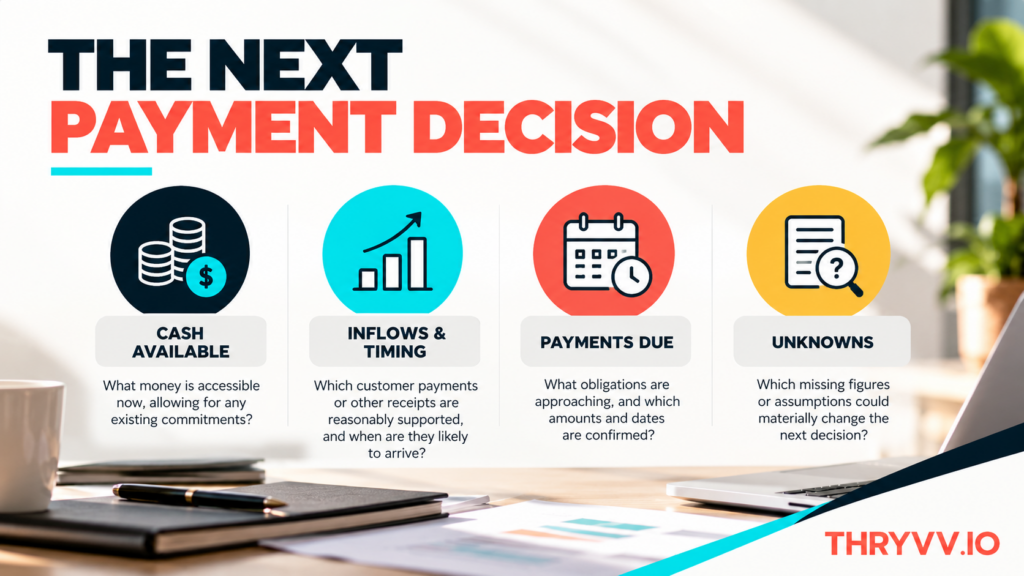
When an obligation is approaching, the most useful starting point is often a clear picture of the money available and the payments that need to be made. Directors do not necessarily need an elaborate financial model to identify the immediate information gap.
A practical first review can focus on four areas:
- Cash available: What money is accessible now, allowing for any restrictions or commitments already attached to it?
- Expected inflows and timing: Which customer payments or other receipts are reasonably supported, and when are they likely to arrive?
- Payments due: What obligations are approaching, and which amounts and dates are confirmed?
- Unknowns: Which missing figures or assumptions could materially change the next decision?
The purpose is to separate what is known from what is expected. A forecast receipt may be reasonable to include in planning, but it should not be treated as cash already available.
Where the information is incomplete, identifying the most important unknown can be more productive than waiting until every report has been finalised. The priority is understanding whether the available information supports the next payment decision.
When the Gap Is Recurring Rather Than Temporary
A single period of tight cash may have an identifiable explanation. Customer receipts may be delayed, stock purchases may have increased, or the business may have made a significant repayment. Understanding the cause helps determine what further information is needed.
A different level of review may be appropriate when the same shortfall keeps returning. If each payment cycle depends on the next customer receipt arriving at precisely the right time, directors may need to examine the underlying operating and funding position more closely.
That review could involve the reliability of expected receipts, payment commitments, margins, working-capital requirements and the assumptions supporting future cash forecasts.
It is important not to draw a conclusion about a business’s financial position from one profit figure or one cash balance. Where there is uncertainty about the ability to meet debts as they fall due, timely professional advice is important.
What to Discuss With a Director’s Advocate
A useful advisory conversation can begin with the specific question the financial reports are not answering. That might be why cash has reduced despite a profitable month, which upcoming payments are creating the greatest uncertainty, or what needs to be checked before committing to another expense.
A Director’s Advocate can help a director organise the available information, identify important gaps and consider what further analysis or professional input may be needed. The objective is to make the next decision with a clearer understanding of the business’s position, rather than relying on the profit figure in isolation.
For a broader discussion of how the timing of money moving through a business can affect its position, read our article on working-capital pressure.
Understanding the Figures Before Making the Next Decision
A profitable result is one part of the financial picture. Directors also need to understand the movement of cash, the reliability of expected receipts and the commitments approaching.
If the figures are not explaining why cash is tight, start with the question you are trying to reconcile. You can contact Thryvv.io to discuss your concern with a Director’s Advocate and explore whether a confidential strategy call would be appropriate.
Need a clear next step?
If this sounds close to what is happening in your business, start with a confidential conversation. We’ll help you work out what matters first.
or call 07 2143 6020
Free. Confidential. No obligation.
Related support: Manage · What we do