
Tax and super obligations can become difficult to manage when they are competing with the day-to-day demands of running a business. A director may be dealing with payroll, suppliers, customer payments and operating costs while tax and super continue to fall due in the background. The amounts may be known individually, but the overall position becomes harder to see when information is spread across accounting systems, adviser correspondence and internal records.
Staying ahead does not necessarily mean every obligation must be paid immediately. A practical starting point is understanding what the business owes, what has been lodged, what remains unpaid and what needs attention next. Once that information is visible, it can be considered alongside cash flow and upcoming commitments, giving the director a clearer basis for making decisions.
Why Tax and Super Obligations Can Become Difficult to Track
Most businesses do not deliberately lose track of their tax and super position. It usually happens gradually when immediate operating demands take priority and different parts of the information are being managed by different people. The director may know that an amount is outstanding, while the accountant is working on a lodgement and the bookkeeper is managing another part of the reporting process.
Knowing there is tax debt or unpaid super does not necessarily provide enough information to manage the position. The director also needs to understand whether obligations have been lodged, what remains outstanding and whether further obligations are approaching. Bringing this information together provides a clearer management view and makes it easier to identify what requires attention.
Start With a Clear View of the Position
A useful way to organise tax and super obligations is to separate the information into four practical categories. This does not replace the accounting system or the work being done by the accountant or bookkeeper. It gives the director a straightforward view that can be reviewed regularly and considered when making decisions about cash flow and the wider business position.
The four areas to track are:
- Due: What tax and super obligations have arisen or are approaching?
- Lodged: What has actually been reported or lodged?
- Unpaid: What remains outstanding?
- Next action: What needs to happen next, who is responsible and what information is still required?
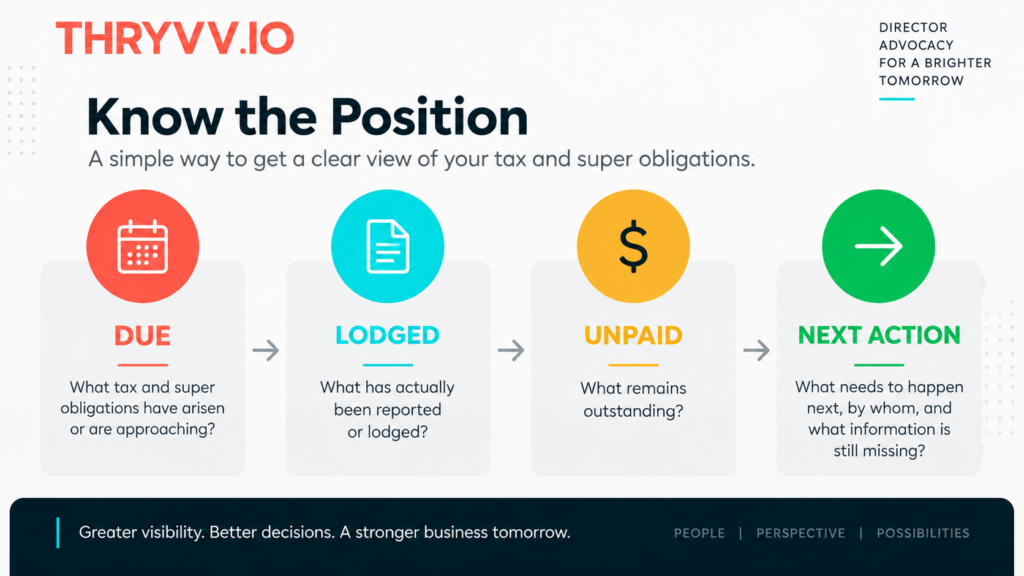
Keeping these areas separate matters because an outstanding payment and an outstanding lodgement are not necessarily the same issue. A simple register can also make conversations with advisers more productive because everyone can work from a clearer picture of the current position.
Connect Tax and Super Obligations to Cash Flow
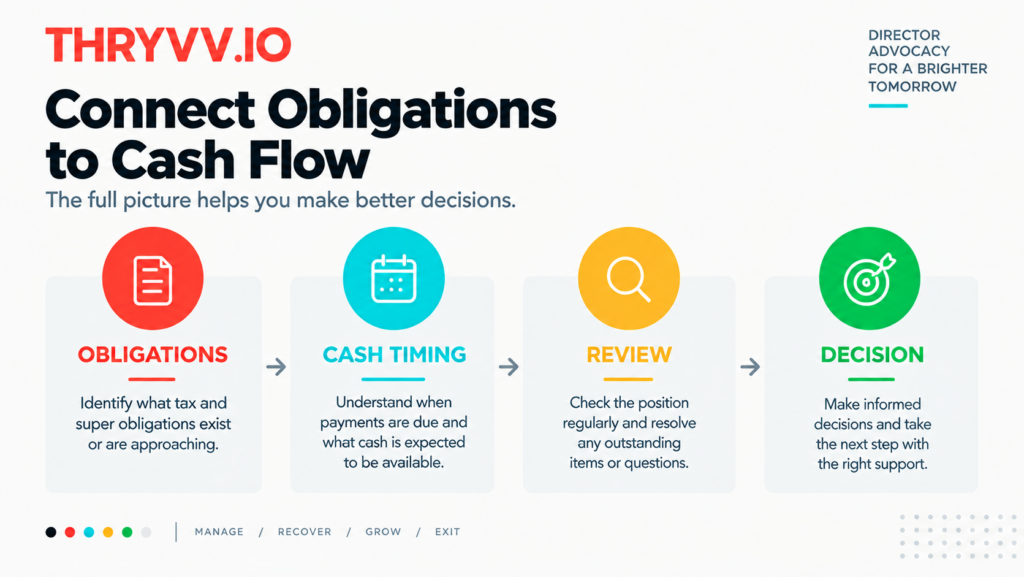
Once the obligations are clear, they need to be considered alongside the company’s cash-flow position. Looking at the tax number alone does not show whether the business has enough available cash to meet the obligation while continuing to fund wages, suppliers and other operating commitments. The timing of expected receipts also matters when the plan relies on future cash becoming available.
A cash-flow forecast can help show when obligations are expected to fall due, what cash may be available and what other commitments are competing for those funds. It can also help the director consider what happens if expected cash arrives later than planned. This is particularly important where the business is relying on future receipts to manage obligations that already exist.
Understand When Director Exposure May Become Relevant
Tax and super obligations can also require attention because some unpaid company liabilities may have consequences for directors personally. Under the ATO’s director penalty regime, directors can potentially become personally liable for certain unpaid company liabilities, including PAYG withholding, net GST and superannuation guarantee charge. How these rules apply depends on the circumstances, so the company’s outstanding balance alone does not determine a director’s personal position.
For directors, the practical issue is recognising when part of the company’s position may require separate advice at director level. If there is uncertainty about personal exposure, it is important to obtain advice based on the actual circumstances rather than relying on assumptions about how company liabilities operate.
Build a Regular Review Into the Business
Getting the position clear once is useful, but the real benefit comes from maintaining that visibility. Tax and super obligations continue to arise as the business trades, so information can quickly become outdated if nobody is responsible for reviewing it. The process should become part of the company’s normal financial management rather than only being revisited when an overdue amount demands attention.
A practical review might cover:
- new obligations that have become due;
- lodgements that have been completed or remain outstanding;
- changes to unpaid amounts;
- whether the cash-flow forecast still supports the current plan; and
- actions or adviser conversations required before the next review.
The director does not need to take over the accountant’s or bookkeeper’s role. The objective is to maintain enough visibility to understand the company’s position, ask appropriate questions and make decisions with better information.
When the Position Points to a Bigger Problem
Sometimes bringing everything together shows that the issue extends beyond overdue tax or super. Obligations may continue accumulating, suppliers may also be overdue, or the company may repeatedly struggle to meet commitments as they arise. These circumstances do not automatically mean the business is insolvent, but they can indicate that the wider financial position needs closer attention.
At that stage, the director may need to consider cash flow, profitability, creditor commitments and future funding requirements together rather than treating each obligation separately. Appropriate advice can help clarify what is driving the pressure and whether the business requires better financial management, a recovery strategy or another pathway.
Staying Ahead Starts With Visibility
Managing tax and super obligations starts with having a reliable view of what is due, what has been lodged, what remains unpaid and what needs to happen next. Reviewing that information alongside cash flow gives directors a better basis for understanding the company’s position and recognising when an issue requires broader attention.
If your business is carrying tax or super obligations and you are unsure how they fit within the wider financial position, talk to one of Thryvv.io’s Director’s Advocates and schedule a confidential strategy call.
Need a clear next step?
If this sounds close to what is happening in your business, start with a confidential conversation. We’ll help you work out what matters first.
or call 07 2143 6020
Free. Confidential. No obligation.