
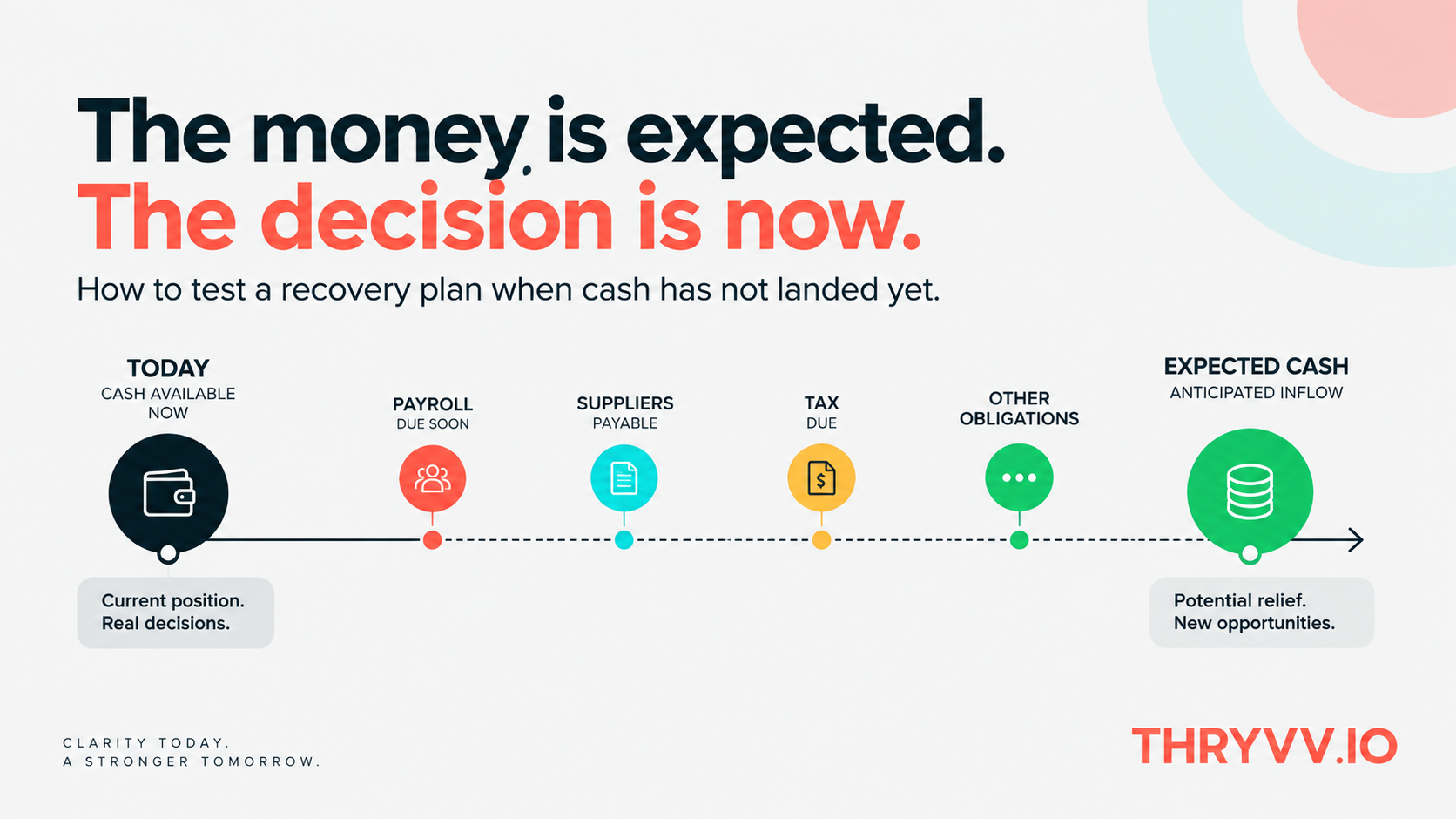
A business can look very different once expected cash arrives. A large receivable may be due. A refund may be expected. Funding may be progressing. A settlement or another anticipated inflow may also change the position.
The challenge is that the business still has to operate before that money reaches the bank. Bills continue to fall due. Employees still need to be paid. Suppliers may be waiting. Directors still have decisions to make.
So the question is not simply whether money is expected. The better question is:
Does the business still have a credible recovery path if that cash arrives late, arrives at a lower amount, or does not arrive at all?
Expected Cash Can Matter, But It Is Not Available Cash
Expected cash should not automatically be ignored.
If there is a reasonable basis to believe money will arrive, it can form part of the recovery picture. The problem begins when expected cash is treated as though it is already available.
There is an important difference between cash in the bank today, money reasonably expected in the future, and money the business simply hopes will arrive.
A recovery decision should recognise all three, but it should not treat them as interchangeable.
If an obligation falls due before the expected receipt arrives, future cash may not solve the immediate problem.
Start With the Position That Exists Today
Before deciding whether the business can afford to wait, understand the current position.
Ask:
- How much cash is actually available now?
- What obligations are already due?
- What becomes due before the expected money is likely to arrive?
- Which payments are critical to continued operations?
- How much operating runway exists if the expected cash is delayed?
This is not about building a perfect forecast.
It is about creating enough visibility to understand the gap between where the business is today and where you expect it to be later.
For broader guidance, see our article on cash flow management for small business.
Test the Timing, Certainty and Sufficiency
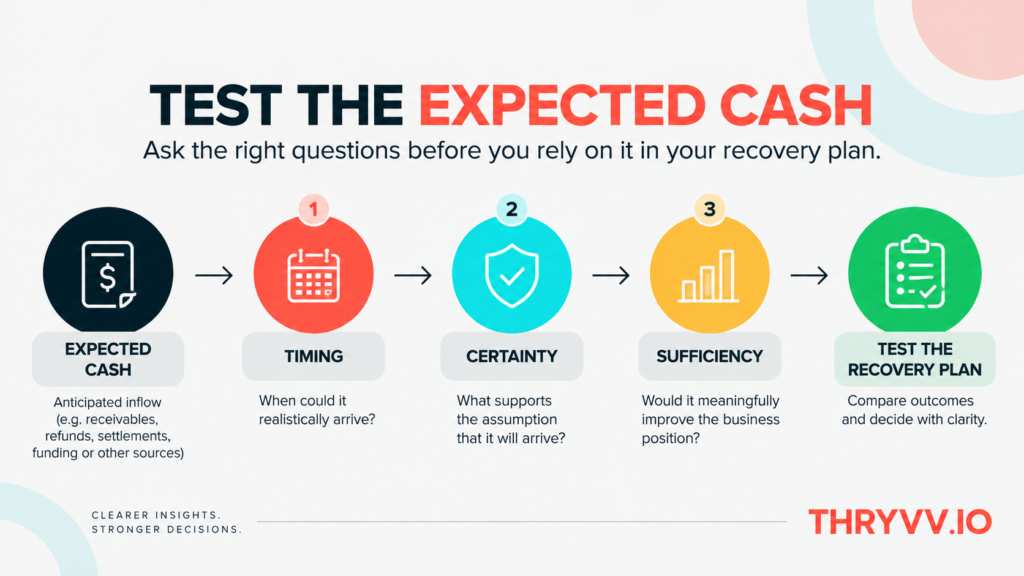
If a recovery plan relies on anticipated cash, three questions matter.
Timing
When is the money realistically expected to become available?
There can be a big difference between an expected date and the day cleared funds are actually available.
Certainty
What supports the assumption that the cash will arrive?
A confirmed receivable is different from an optimistic expectation that has already moved several times.
Sufficiency
If the money arrives, does it materially improve the position?
Receiving cash does not automatically mean the underlying recovery problem has been solved. Consider what remains after that money is used.
Test More Than One Scenario
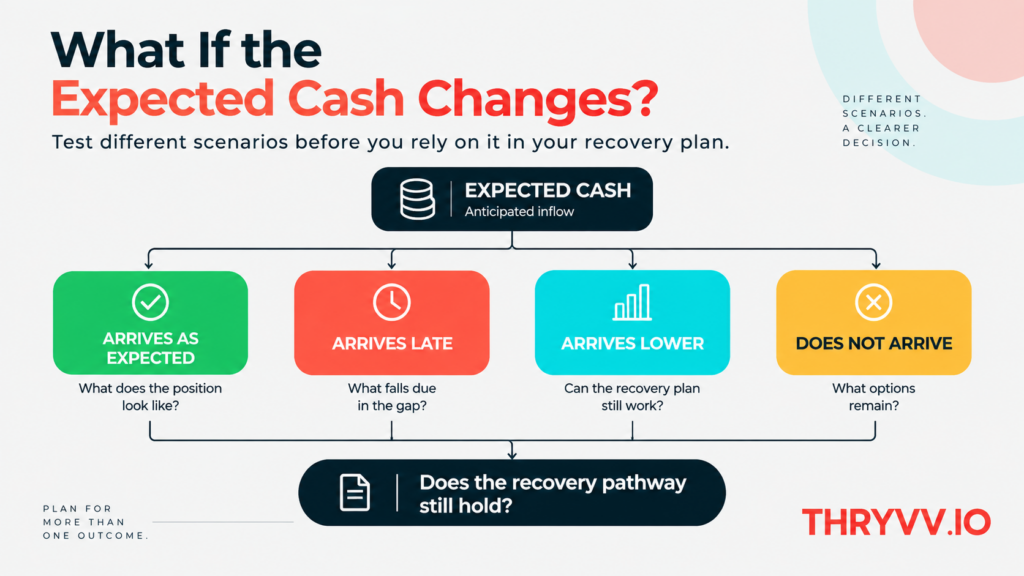
A recovery plan should not only answer:
What happens if everything goes according to plan?
It should also test what happens if assumptions change.
Consider four simple scenarios:
- the cash arrives as expected;
- the cash arrives late;
- the amount is lower than expected;
- the cash does not arrive.
Then ask what happens to obligations, operating capacity and available options in each case.
The point is not to build a complicated financial model. It is to understand how dependent the recovery strategy is on one future event.
Know Your Runway Before You Decide to Wait
Waiting can be a decision, but it should be an informed one.
If the business has enough runway to meet critical obligations while an expected receipt is reasonably progressing, waiting may form part of a considered recovery strategy.
If the business is already running out of room, the same delay may have a very different consequence.
When several pressures are competing for attention, it can also help to identify what a director should prioritise when a business is under financial pressure..
Set Trigger Points Before the Position Changes
One risk of relying on expected money is that the decision keeps moving with it.
The payment is expected next week. Then the date changes. Then another explanation arrives. Then another week passes.
Set trigger points in advance.
For example, decide what would cause the recovery plan to be reviewed if the date changes, the amount reduces, confirmation does not arrive, or another critical obligation falls due first.
Trigger points turn passive waiting into active decision management.
When Expected Cash Supports Recovery
Expected cash can genuinely support a recovery pathway when the receipt is reasonably supported, the timing fits within the available runway, and the amount meaningfully improves the position.
The concern is when the recovery strategy works only if every assumption goes right.
If dates keep moving, the amount becomes uncertain, or critical obligations fall due first, continuing to wait may simply postpone the decision.
That does not automatically mean there is no recovery option. It means the plan should be reassessed using the circumstances that exist now.
For a broader recovery perspective, see A New Era in Business Turnarounds.
A Recovery Decision Should Be Based on What You Can See
Expected cash is part of the picture.
It should not be the whole picture.
A stronger recovery assessment considers cash available now, current obligations, runway, expected cash, timing, certainty, alternative scenarios and trigger points.
The goal is not to remove uncertainty. The goal is to understand how much of the recovery strategy depends on assumptions and what happens if those assumptions change.
If your recovery plan depends heavily on money that has not yet arrived, a Director’s Advocate can help you understand the current position, test the assumptions and consider what options may still be available.
Talk to one of Thryvv.io’s Director’s Advocates and schedule a confidential strategy call.
Need a clear next step?
If this sounds close to what is happening in your business, start with a confidential conversation. We’ll help you work out what matters first.
or call 07 2143 6020
Free. Confidential. No obligation.
Related support: Manage · What we do